Suspended Scaffolding: Types, Safety, Uses & Equipment Guide
Quick Answer
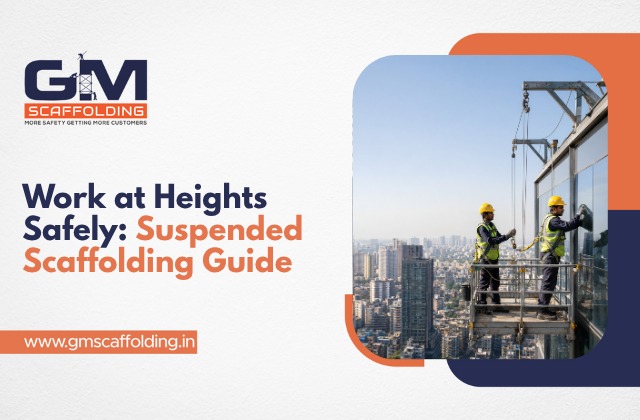
Suspended scaffolding is a temporary work platform hung from an above structure utilizing wire ropes, chains, or hoists – allowing workers to access building facades, rooftops, and high-rise exteriors without ground-supported structures. Scaffold-related injuries make up 72% of all scaffold incidents in the construction industry (OSHA, 2025). Every secure suspended scaffold operation requires three non-negotiable pillars: proper equipment selection, trained operators, and daily inspection.
Quick Overview Table
| Aspect | Gist |
| What It Is | The platform hung from the overhead structure via ropes or hoists |
| Main Types | Swing stage, single-point, multi-point, catenary, float, interior hung |
| Primary Uses | Facade maintenance, painting, glass cleaning, and repairs on high-rises |
| Key Safety Standard | OSHA 29 CFR 1926 Subpart L & ANSI A10.8 |
| Critical Equipment | Hoists, wire ropes, tie-backs, guardrails, and personal fall arrest |
| Key Safety Stat | 72% of scaffold accidents are linked to equipment or setup failures |
Table of Contents
- Introduction
- What Is Suspended Scaffolding and What Are Its Types?
- Suspended Scaffolding Equipment: What Every System Needs
- Suspended Scaffolding Safety: Critical Requirements
- Suspended Scaffolding Uses: Where It Works Best
- Suspended Scaffolding Comparison & Maintenance Uses
- Conclusion
- FAQs
Introduction
Working on high-rise buildings poses one of construction’s most persistent challenges: how do you safely transport workers to the facade, 20, 30, or 50 storeys up, with the equipment and materials they require, when standard ground-supported structures are impractical or impossible?
For thousands of construction and maintenance crews worldwide, the solution is a well-designed suspended scaffold system. The article discusses the various types available, the apparatus used to keep them safe, their most popular applications, and the safety rules all operators must adhere to.
What Is Suspended Scaffolding and What Are Its Types?
What Is Suspended Scaffolding?
Suspended scaffolding is a temporary raised work platform that is supported from above rather than from the ground. It is suspended from structural anchor points at the top of a building or structure via wire ropes, chains, or hoist systems. The platform may be raised and lowered to meet various working heights, making it suitable for variable-height jobs that stationary structures cannot handle efficiently.
- Works independently of ground conditions—suitable for urban settings and waterfront buildings
- Adjustable height enables a single rig to cover a complete building facade in just one deployment
- Faster deployment than typical scaffolding for single-face or full-perimeter facade work
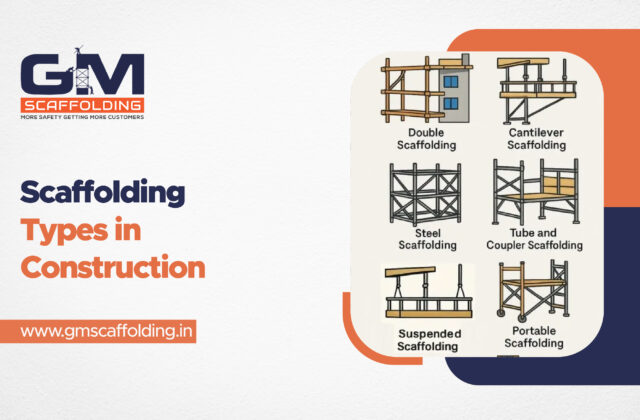
Suspended Scaffolding Types
The appropriate suspended scaffolding type is determined by the building’s geometry, task requirements, load, and available anchor points. Each type has a unique design tailored to certain site conditions.
- Two-Point Adjustable Suspension Scaffold (Swing Stage)
- Single-Point Adjustable Suspension Scaffold (Bosun’s Chair)
- Multi-Point Adjustable Suspension Scaffold
- Catenary Scaffold
- Float Scaffold
- Interior Hung Scaffold
Suspended Scaffolding Equipment: What Every System Needs
A suspended scaffolding equipment set is only as secure as its weakest link. Every element must be rated to match the entire system load—including the platform dead weight, people, tools, and supplies.
Equipment Items in Suspended Scaffolding
- Outrigger beams
- Wire ropes/cables
- Electric / manual hoist
- Suspended platform
- Tie-back ropes
- Guardrails (3-sided)
- Personal Fall Arrest
- Counterweights
Suspended Scaffolding Safety: Critical Requirements
Effective suspended scaffolding safety requires more than just protective equipment; it also necessitates thorough training, daily inspection, and precise load management at all stages of operation. According to OSHA, scaffolding is one of the top ten most often violated construction standards each year, with falls from scaffolds accounting for a significant portion of construction fatalities.
- Pre-Use Inspection Checklist
- Mandatory Safety Rules for Operators
Suspended Scaffolding Uses: Where It Works Best
Suspended scaffolding is primarily used when ground-supported scaffolding is technically unfeasible, prohibitively expensive, or physically impossible due to site limits or building height. The following are the most common real-world uses in the building, maintenance, and industrial sectors.
- High-rise facade maintenance
- Commercial window cleaning
- Exterior painting and coating
- Caulking and joint sealing
- Structural repair and inspection
- Glass curtain wall replacement
- Bridge underside maintenance
- Industrial tank and silo work
Suspended Scaffolding Comparison & Maintenance Uses
Suspended Scaffolding vs Supported Scaffolding
Both types perform the same basic function — providing a safe raised work platform — but they differ dramatically in how they are designed, deployed, and maintained.
| Factor | Suspended Scaffolding | Supported Scaffolding |
| Support Direction | From above — ropes, hoists, anchor pts | From below — ground-resting standards |
| Height Adjustment | Continuously adjustable during use | Fixed levels; must be rebuilt to change |
| Best Suited For | High-rise facades, no ground access | Low-to-mid rise; stable ground available |
| Setup Speed | Faster per floor — one roof rig covers all | Requires floor-by-floor build-up |
| Ground Dependency | None — works over water, traffic, etc. | Requires stable ground support |
| Load per Platform | Typically 500–750 kg rated platform load | Higher total loads are possible at ground level |
| Primary Safety Risk | Rope or hoist failure; fall from height | Collapse from overloading or a poor base |
Suspended Scaffolding for Building Maintenance
Many major buildings have permanent suspended scaffold anchor points built into the roof structure during construction to enable faster, lower-cost deployment of maintenance rigs over the building’s lifetime.
- Regular facade inspections every 3-5 years require secure high-level access
- Sealant and waterproofing replacement necessitates precise positioning at each joint
- Permanent davit arms and roof tracks shorten deployment time for repeated maintenance
- Building management teams increasingly prefer suspended rigs over mobile elevating work platforms for cost efficiency during regular facade cycles
For dependable scaffolding rental in Coimbatore, GM Scaffolding offers certified suspended scaffold systems, professional erection teams, and complete project safety documentation, ensuring each project meets OSHA and IS code standards from the start.
Conclusion
A suspended scaffolding system, such as a swing stage, single-point bosun’s chair, catenary rig, or multi-point platform, is one of the most effective tools in construction for providing safe, regulated access to building facades and elevated structures. Invest in the correct type, examine every component before each use, and train every operator, and a suspended scaffold system will keep your crew safe from the first lift to the last.
FAQs
1. What is suspended scaffolding in construction?
Suspended scaffolding is a platform supported by ropes or cables, allowing workers to access lofty areas.
2. Where is suspended scaffolding commonly used?
It is often used for high-rise building maintenance, including painting, cleaning, and external repairs.
3. What are the different types of suspended scaffolding?
Swing stage scaffolds, multi-point adjustable scaffolds, and two-point suspended scaffolds are all common varieties.
4. What safety measures are required for suspended scaffolds?
Workers must utilise safety harnesses, secure platforms correctly, and inspect equipment before use.
5. What equipment is used in suspended scaffold systems?
Platforms, ropes, hoists, guardrails, harnesses, and suspension supports are used throughout the system.
6. What is the difference between suspended scaffolding and supported scaffolding?
Suspended scaffolding hangs from above, whereas supported scaffolding stands on the ground with structural support.