Scaffolding Clamps Names: Types, Uses & Safety Guide
Quick Answer
Scaffolding clamps are also known as right-angle clamps, swivel clamps, putlog clamps, shikanja clamps, sleeve couplers, and gravlock clamps. Each form joins scaffold tubes at different angles and serves a distinct structural or safety purpose on building sites. Selecting the appropriate clamp for the joint type, load, and pipe diameter is critical for both structural stability and worker safety.
Quick Overview Table
| Topic | What This Guide Covers |
| Blog focus | Names, types, uses and safety of scaffolding clamps |
| Clamps covered | Right angle, swivel, putlog, shikanja, sleeve, gravlock |
| Applications covered | Load-bearing joints, angled frames, temporary structures |
| Safety practices | Torque limits, inspection routine, certified fittings only |
| Selection guide | Match clamp type to joint angle, load, and pipe diameter |
| Target readers | Contractors, site engineers, builders, safety officers |
Table of Contents
- Introduction
- Scaffolding Clamps: Types, Functions and Importance
- Complete Scaffolding Clamps Names: Types and Uses
- Scaffolding Clamps Comparison Table
- Applications of Scaffolding Clamps by Construction Scenario
- Specialised Scaffolding Clamps and Couplers
- Scaffolding Clamp Selection and Safety Guidelines
- Common Mistakes to Avoid on Site
- FAQs
- Conclusion
Introduction
Every scaffold construction is determined by the reliability of its connections, which depend on knowing the correct scaffolding clamp names and using the appropriate type for each joint. For site engineers, contractors, and safety authorities, using the wrong clamp — or the correct clamp incorrectly — is not a minor issue. It is a structural risk that threatens the entire platform.
This guide covers all key clamp types used in modern scaffolding, explains when and why they are employed, and provides construction professionals with practical safety and selection advice.
Scaffolding Clamps: Types, Functions and Importance
What Is a Scaffolding Clamp?
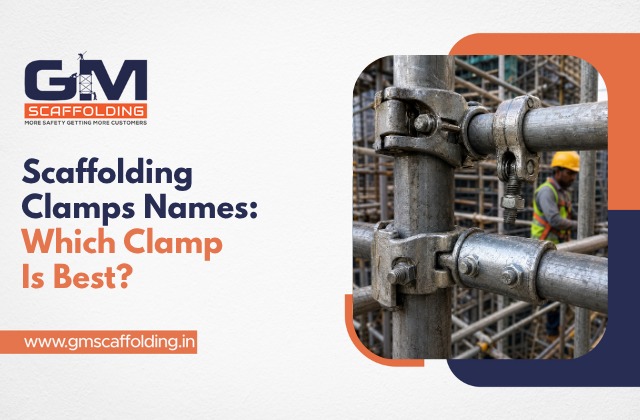
A scaffolding clamp, also known as a scaffold coupler or scaffold fitting, is a mechanical connector that joins two or more steel scaffold tubes. Clamps are forged or cast from steel, galvanised for corrosion protection, and designed to hold tubes under strain securely. They are the structural nodes of all tube-and-coupler scaffolding systems.
Why Scaffolding Clamps Names Matter on Site
When a site engineer specifies a “right-angle clamp” rather than a “swivel clamp,” the choice affects whether a load-bearing joint functions properly or fails under stress.
- Accurate procurement
- Safe erection
- Inspection and audit
- Training and certification
Complete Scaffolding Clamps Names: Types and Uses
The following are the most common names for scaffolding clamps used in building projects in India and worldwide.
Right Angle Clamp (Fixed Coupler)
This clamp, also known as the right-angle scaffolding clamp or the fixed coupler, is the most commonly utilised in any scaffolding system. It links two tubes at a 90-degree angle and serves as the primary load-bearing connector in traditional tube-and-coupler scaffolding.
Application: Mainframe connections, standards to ledgers, primary structural joints.
Swivel Clamp (Universal Coupler)
The swivel scaffolding clamp links two tubes at any angle between 0 and 360 degrees, making it necessary whenever the scaffold design deviates from a conventional 90-degree grid. Its applications include bracing, raking, and angular connections.
Applications: Diagonal bracing, angled supports, uneven buildings, facade scaffolding.
Putlog Clamp (Single Coupler)
The putlog clamp attaches a putlog or transom tube to a ledger at a right angle, but is intended only for non-primary, light-duty connections. It is not classified as a structural coupler and is intended to connect secondary tubes that do not support the primary platform load.
Application: Connecting putlogs or transoms to ledgers; non-structural horizontal tube connections.
Sleeve Coupler (Extension Coupler)
A sleeve coupler connects two scaffold tubes end-to-end in a straight line, substantially increasing tube length within a standard or ledger run. It is also known as an extension coupler and is required if tubes cannot span the necessary distance without a connection.
Application: Extending standards, ledgers, or any tube that needs a mid-span inline connection.
Gravlock Coupler (Beam Clamp)
The gravlock coupler attaches a scaffold tube to a structural steel beam or I-section, bridging the gap between the scaffold tube and the existing structural steel. It is the conventional technique when scaffolding needs to be connected to a steel frame rather than to a masonry or concrete structure.
Application: Connect scaffold tubes to steel beams, RSJs, and structural ironwork on industrial sites.
Scaffolding Clamps Comparison Table
This quick-reference comparison of all scaffold coupler types allows site teams and procurement managers to quickly select the appropriate clamp for each joint type, load requirement, and construction scenario:
Different Scaffolding Clamp Names & Uses
| Clamp Name | Joint Angle | Load Rating | Primary Use |
| Right Angle Clamp | 90° fixed | 6.25 kN | Main structural frame joints |
| Swivel Clamp | 0°–360° | 4.5 kN | Diagonal bracing and angled tubes |
| Putlog Clamp | 90° (open) | 3.25 kN | Secondary tube connections only |
| Sleeve Coupler | 180° inline | High compressive | Tube-to-tube inline extensions |
| Gravlock Coupler | Variable | Beam-dependent | Tube to structural steel beam |
| Shikanja Clamp | Multi-angle | Variable | Temporary adjustable connections |
Applications of Scaffolding Clamps by Construction Scenario
Here’s how different clamps are used in common construction scenarios:
| Construction Scenario | Recommended | Clamp Reason |
| Standard building facade | Right angle + swivel | 90° grid with diagonal bracing |
| Industrial steel frame | Gravlock + right angle | Ties to structural steelwork |
| Bridge maintenance scaffold | Swivel + sleeve | Irregular angles, extended spans |
| Residential renovation | Right angle + putlog | Standard frame with light transoms |
| Temporary access platform | Shikanja + swivel | Adjustable, quick-erect connections |
| Suspended / cantilever platform | Right angle (rated) only | High load; no lower-rated substitutes |
Specialised Scaffolding Clamps and Couplers
Shikanja Clamp: Features and Uses
The shikanja clamp is a popular adjustable clamp used in Indian building and scaffolding. The word is typically used to describe screw-type or wing-nut-adjusted clamps that can hold tubes and pipes at a variety of angles without using bolt tools to tighten. It is especially common in temporary, fast-erect scaffolding and formwork applications on South Asian building projects.
- Fast adjustment
- Temporary structures
- Versatile grip
- Not for primary structure
Scaffold Coupler Types
Aside from the primary clamp kinds, construction experts should recognise many more scaffold coupler types that appear in complex scaffold designs, TW engineering drawings, and supplier catalogues:
- Board Retaining Clip
- Brace Clip
- Spigot (Joint Pin)
- Base Plate Coupler
- Forged vs Cast Couplers
Scaffolding Clamp Selection and Safety Guidelines
Safety Tips and Best Practices for Scaffolding Clamps
Correct safety advice and practices for scaffold clamps are a site’s legal necessity, not an optional standard.
- Torque to specification
- No damaged clamps
- Never mix clamp types at load-bearing joints
- Use certified clamps only
- Scaffold safety components should be checked after a storm or impact
How to Choose the Right Scaffolding Clamp
Selecting the correct clamp among all scaffolding clamp names available boils down to four essential questions that must be answered for each joint in the scaffold design before procurement begins:
- What angle is the joint?
- Is the joint load-bearing?
- What tube diameter is involved?
- What is the connection type?
To source certified clamps and scaffolding components in South India, contact authorised scaffolding dealers in Coimbatore. They stock EN 74 and BS 1139-compliant fittings and can advise on load-rated clamp selection based on your project type and site conditions.
Common Mistakes to Avoid on Site
The following are the most prevalent site mistakes that cause scaffold failures, safety accidents, or failed inspections:
- Using swivel clamps as primary vertical connectors
- Over-tightening couplers
- Reusing damaged clamps without inspection
- Mixing coupler standards
- Ignoring the shikanja for temporary props
Conclusion
Every safe, compliant scaffold structure depends on the people erecting it knowing their scaffolding clamp names and understanding exactly which type belongs at each joint. From the fundamental structural load-bearing right-angle coupler to the multipurpose swivel clamp, tube-extending sleeve coupler, and beam-tying gravlock, each clamp has a specific engineering function that cannot be safely improvised or substituted on-site. Use this guide as an on-site reference for clamp selection, inspection, and safety procedures.
FAQs
1. How many types of scaffolding clamps are there?
Scaffolding clamps are classified into many types: right-angle clamps, swivel clamps, putlog clamps, sleeve clamps, and shikanja clamps.
2. What is a scaffolding clamp?
A scaffolding clamp is a fitting that firmly connects scaffolding tubes and components of a scaffolding system.
3.What is the most common type of scaffolding clamp?
The right-angle clamp is the most frequent scaffolding clamp found in building projects.
4. What are the uses of scaffolding clamps in construction?
Scaffolding clamps are used to connect tubes, give structural stability, and ensure the safety of scaffold systems.
5. Where is a shikanja clamp commonly used?
Shikanja clamps are often used in construction to secure scaffolding structures and formwork components.
6. How do you choose the right scaffolding clamp for a project?
The load requirements, tube size, connection type, and project safety standards should all be considered when selecting a scaffolding clamp.