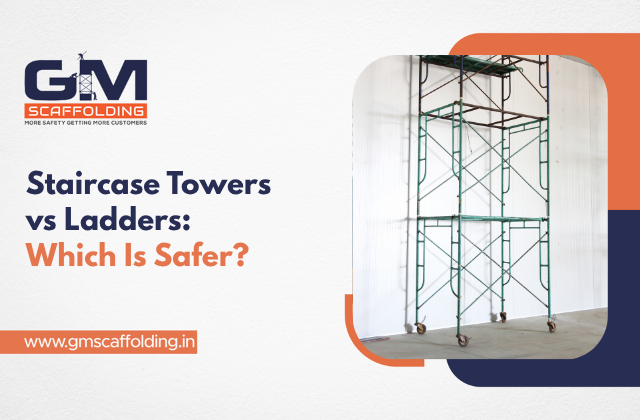
Staircase Towers Vs Ladder Access: When To Use Each
Quick Answer
In Staircase Towers vs Ladder Access in Scaffolding, staircase towers are better for frequent, multi-user movement and tool carrying. Ladder access suits shorter-duration, lower-traffic work where space is tight and use is controlled. The choice matters on Indian sites because infrastructure capex for 2025-26 is ₹11.21 lakh crore, keeping construction activity strong.
Quick Overview
| Factor | Staircase Towers | Ladder Access |
| Best For | Frequent site movement | Short, controlled access |
| User Traffic | Multiple workers | Limited users |
| Tool Carrying | Better for movement | Restricted while climbing |
| Emergency Exit | Easier evacuation | Less convenient |
| Site Space | Needs more footprint | Fits tighter setups |
This snapshot follows NASC’s access hierarchy, OSHA scaffold-access rules, and HSE ladder guidance.
Table Of Contents
- Why Scaffolding Access Choice Is Critical for Safety
- Best Situations for Ladder Access in Scaffolding
- Scaffolding Access Safety and Compliance Guidelines
- How To Choose For Your Site
- FAQs
- Conclusion
Why Scaffolding Access Choice Is Critical for Safety
Why The Access Choice Matters
On a live scaffold, access is not just a way up and down. It affects worker flow, fatigue, evacuation speed, and how safely different trades share the same structure. NASC says access planning should consider scaffold size, number of users, type of work, and emergency requirements, while HSE requires competent design, erection, and supervision throughout the scaffold lifecycle.
- Higher worker traffic usually benefits from safer, easier circulation.
- Emergency or evacuation planning may require easier access routes.
- Any scaffold arrangement must be handled by competent people.
- Tower scaffolds used in construction must be inspected after assembly and then every 7 days when a person could fall 2 metres or more.
The best decision comes from usage pattern, not habit. If the scaffold behaves like a shared access route for repeated movement, staircase towers usually offer the better operational fit. If access is limited, low-risk, and brief, ladder access can still be practical when it is secured and controlled properly.
Also Read: https://blog.gmscaffolding.in/advancements-in-scaffold-technology/
When Staircase Towers Make More Sense
Staircase towers are the stronger choice when workers will move up and down often, when several people use the scaffold at once, or when evacuation needs matter. NASC places temporary staircase towers above ladder access bays in its hierarchy of safe access and says staircases are safer, support some manual handling, and allow easier emergency access.
“The NASC strongly recommend the use of staircases over ladders.”
| Situation | Why Stair Towers Work Better |
| Multi-trade sites | Better traffic flow |
| Repeated upper-level access | Less climbing strain |
| Tool-carrying teams | Easier hand movement |
| Emergency-sensitive projects | Faster evacuation route |
| Large scaffold runs | Better shared access |
OSHA also requires stair towers to include stairrails on both sides, adequate handholds, landing platforms at each level, slip-resistant surfaces, and stair widths of at least 18 inches between stairrails. That makes them especially suitable when access itself becomes part of daily workflow instead of occasional entry. (osha.gov)
Also Read: https://blog.gmscaffolding.in/scaffolding-rental-mistakes/
Best Situations for Ladder Access in Scaffolding
When Ladder Access Makes More Sense
Ladder access is more appropriate when the job is short-term, worker traffic is limited, and a risk assessment shows a more suitable option is not justified. NASC states ladders should only be used where the risk is low and duration is short, or where site conditions cannot reasonably be altered.
- Useful for smaller scaffold setups with controlled access.
- Ladders used for access should be tied and extend at least 1 metre above the landing point.
- OSHA says portable ladders used to reach an upper landing should extend at least 3 feet above it, or be secured with a grasping device provided.
- Workers must face the ladder, keep a hand on it, and must not carry loads that could cause loss of balance.
For compact projects or controlled maintenance access, ladders can be efficient. Still, they demand stricter behaviour from users. For contractors reviewing Scaffolding ladder for rent in Coimbatore, ladder access usually fits best when the crew size is small, the climb frequency is modest, and site supervisors can control who uses the scaffold and how.
Staircase Towers Vs Ladder Access At A Glance
The practical difference is simple. Staircase towers are built for easier circulation. Ladder access is built for controlled entry. OSHA allows both, but the safer option depends on traffic, climb height, load in hand, and whether access is occasional or part of the work routine itself.
| Comparison Point | Staircase Towers | Ladder Access |
| Access Frequency | High | Low to moderate |
| User Comfort | Better for repeated trips | More physically demanding |
| Carrying Small Tools | More practical | More restricted |
| Space Requirement | Larger | Smaller |
| Evacuation Ease | Better | Lower |
| Behaviour Control | Less strict | More strict |
- OSHA permits ladders, stairway-type ladders, stair towers, ramps, and prefabricated frames as scaffold access types.
- Hook-on or attachable ladders on supported scaffolds above 35 feet need rest platforms at maximum 35-foot intervals.
- Stairway-type ladders need rest platforms every 12 feet, while stair towers require landing platforms at each level.
If workers are constantly moving between lifts, staircase towers usually save time and reduce access friction. If they only need controlled entry to a limited work area, ladder access can remain adequate. The deciding question is not which system is cheaper alone, but which one matches daily movement on your site without creating avoidable risk.
Scaffolding Access Safety and Compliance Guidelines
Safety And Compliance Points
The safest access method is the one that fits the task, the scaffold design, and the behaviour of real users. HSE says scaffolds must be designed, erected, altered, and dismantled only by competent people, and tower scaffolds must be inspected after assembly and at suitable intervals, with stricter inspection frequency on many construction sites. (hse.gov.uk)
“Scaffolds must be designed, erected, altered and dismantled only by competent people.” (HSE)
Ladder Access Basics
Ladders used for access should be tied, extend above the landing to give a secure handhold, and be kept clear at the top and bottom. OSHA also requires users to face the ladder, keep at least one hand on it, and avoid carrying any object that could make them lose balance and fall.
Staircase Tower Basics
Stair towers need proper handrails, stairrails, slip-resistant treads, landings at each level, and enough width to move safely between stairrails. NASC also notes that staircase systems have loading limits, that some material may be manually handled on them, and that materials must never be stored on staircase towers. (osha.gov)
NASC gives one especially practical warning: if subcontractors are likely to carry materials up or down a ladder, the client and contractor should consider providing a staircase at design stage. That is a strong sign that staircase towers are usually the better answer when access becomes part of the work process, not just the route to it.
Also Read: https://blog.gmscaffolding.in/choosing-the-right-scaffold-height-for-safety-and-efficiency/
How To Choose For Your Site
A simple site check makes the decision easier. Look at user traffic, task duration, tool carrying, evacuation needs, and how tightly access can be controlled. NASC’s own hierarchy places staircase towers ahead of ladder access bays, which is a useful practical rule when two options seem technically possible.
- Choose staircase towers for frequent daily movement.
- Choose staircase towers when multiple trades share access.
- Choose staircase towers when teams may carry tools or small items regularly.
- Choose ladder access for short-duration, low-risk, controlled use.
- Choose ladder access only when securing, landing extension, and user discipline can be maintained.
For most busy construction and maintenance sites, staircase towers win on usability and safety. Ladder access still has a place, but mainly where the project is smaller, movement is limited, and site control is strong. If access will be frequent, shared, or rushed, staircase towers are usually the better long-term choice.
FAQs
1. Is A Staircase Tower Always Safer Than Ladder Access?
Not automatically, but it is often the safer and more practical choice for repeated use, shared access, and evacuation-sensitive sites. NASC ranks temporary staircase towers above ladder access bays in its access hierarchy, while OSHA requires more built-in features such as rails, landings, and slip-resistant treads.
2. When Is Ladder Access Acceptable On Scaffolding?
Ladder access is acceptable when use is low-risk, short-duration, and properly controlled. NASC says ladders should only be used when a more suitable option is not justified or site features cannot reasonably be changed. The ladder must also be secured and set up for safe access and exit.
3. Can Workers Carry Tools Or Materials On Ladder Access?
They should not carry anything that could affect balance. OSHA says workers must keep a hand on the ladder and must not carry a load that could cause a fall. NASC recommends tools be carried in a belt or backpack, or hauled separately by rope.
4. Does A Scaffold Access Ladder Need To Extend Above The Landing?
Yes. HSE says ladders used to reach another level should be tied and extend at least 1 metre above the landing point. OSHA similarly requires portable ladders used to access an upper landing to extend at least 3 feet above it, or have equivalent secure support.
5. Are Staircase Towers Mandatory On Every Project?
No. Regulations allow several access types, including ladders and stair towers. But both HSE and NASC make it clear that the choice must be justified by risk assessment, user needs, and site conditions. When safer access is reasonably practicable, staircase towers are more likely to be expected.
6. Do Staircase Towers Take More Space Than Ladders?
Usually, yes in practical site planning, because staircase towers need a dedicated tower arrangement with landings and handrailed stairs. Ladder access fits into tighter scaffold layouts more easily. That said, extra space can be worth it when user traffic is high or evacuation routes need to be simpler and safer.
7. Can Materials Be Stored On A Staircase Tower?
No. NASC says materials must not be stored on staircase towers. Stair systems have load limits for people, tools, and movement, and repeated overloading can lead to fatigue or unsafe use. Stair towers are for access and egress, not for turning into an extra storage zone.
8. What Is The Better Choice For A Home Renovation Job?
For a small, short-term, tightly controlled renovation, ladder access may be enough. For larger residential work with repeated trips, multiple workers, or frequent movement of tools, staircase towers usually make the site easier to use and safer day after day. The real answer depends on traffic, duration, and supervision.
Conclusion
Staircase towers and ladder access both have valid roles in scaffolding, but they are not interchangeable. Staircase towers suit frequent movement, shared use, and safer evacuation. Ladder access suits lower-traffic, shorter-duration work where setup can be tightly controlled. When in doubt, choose the system that reduces climbing strain, improves behaviour on site, and supports safer daily access.
Planning scaffold access for your next project? Start with traffic, task duration, and how often your team will move between levels. When you need a practical temporary access option, review your site needs first, then explore Scaffolding ladder for rent in Coimbatore or staircase-based solutions that match the way your crew actually works.
References
- National Access and Scaffolding Confederation, Access and Egress from Scaffolding, via Ladders and Stair Towers etc.
- Occupational Safety and Health Administration, 29 CFR 1926.451 Scaffolds and 29 CFR 1926.1053 Ladders. (osha.gov)
- Occupational Safety and Health Administration, A Guide to Scaffold Use in the Construction Industry.
- Health and Safety Executive, Scaffolds, Tower Scaffolds, and Safe Use of Ladders and Stepladders. (hse.gov.uk)
- India Brand Equity Foundation, Infrastructure Sector in India. (India Brand Equity Foundation)