Key Differences Between Cuplock and Ringlock Scaffolding
Introduction:
Scaffolding is the backbone of safe, efficient construction work. As building designs become more complex, contractors rely on modular scaffolding systems like Cuplock and Ringlock to meet the demands of speed, safety, and accuracy. Understanding the key differences between Cuplock and Ringlock scaffolding helps construction teams select the right system, avoid costly mistakes, and increase productivity.
Why Scaffolding Systems Matter in Construction
- A good scaffolding system impacts:
- Worker safety
- Construction speed
- Material handling
- Project costs
That’s why choosing between Cuplock and Ringlock requires more than a quick price comparison — it requires knowing their strengths, limitations, and best-use cases. For businesses looking for reliable support, consulting scaffolding contractors in Coimbatore can help ensure the right system is selected for your project’s specific needs.
Where Cuplock and Ringlock Scaffolding Are Commonly Used
Both systems appear in:
- Building renovations
- Commercial construction
- Bridge and infrastructure work
- Industrial maintenance
- High-rise developments
However, their applications differ when the work involves complex shapes, heavy loads, or irregular building lines.
What Is Cuplock Scaffolding?
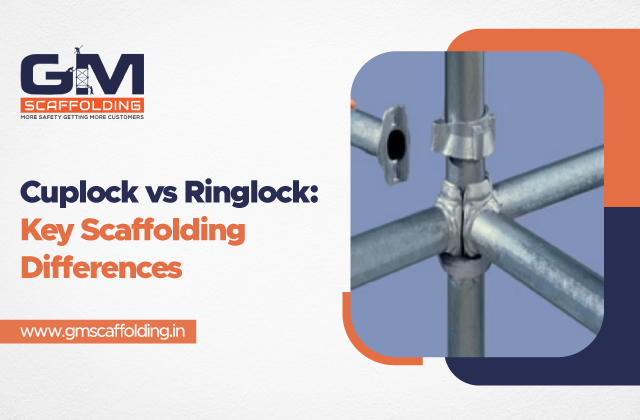
Cuplock scaffolding is a popular modular system recognized for its simple, cuplock-based connection mechanism.
Design Structure and Components of Cuplock
Cuplock’s design uses:
- Vertical standards with fixed lower cups
- Movable upper cups to lock the ledgers
- Ledgers (horizontal supports)
- Braces for stability
The “cup and blade” mechanism allows multiple ledgers to lock into the standard at one point.
Strengths and Limitations of Cuplock Systems
Strengths:
- Extremely strong and stable
- Ideal for repetitive structures
- Faster setup than traditional tube-and-fitting
- Great for formwork and shoring
Limitations:
- Less flexible than Ringlock
- Difficult to adapt to irregular structures
- Heavier components mean more labour effort
Cuplock excels where the structure is consistent and repetitive.
What Is Ringlock Scaffolding?
Ringlock scaffolding is a newer, more advanced modular system designed for flexibility and speed.
Design Structure and Components of Ringlock
- Standards with rosettes (rings) at fixed intervals
- Ledgers with wedge heads
- Diagonal braces for rigidity
- Optional decks, staircases, and guardrail systems
Workers simply insert the ledger into the rosette and hammer the wedge to lock it in place.
Strengths and Limitations of Ringlock Systems
- Highly flexible for irregular shapes
- Faster assembly due to fewer parts
- Excellent for industrial and high-rise projects
- Great compatibility with accessories
- Often more expensive than Cuplock
- Slight learning curve for new crews
Ringlock is the preferred system where speed, adaptability, and safety are top priorities.
Key Differences Between Cuplock and Ringlock Scaffolding
Now let’s explore the key differences between Cuplock and Ringlock scaffolding, which are essential for choosing the right system.
Structural Design: Vertical and Horizontal Connections
- Cuplock: Uses cup joints — strong but less adaptable.
- Ringlock: Uses rosettes — allowing 360° connections and greater flexibility.
Speed of Assembly and Labour Requirements
- Ringlock is generally faster, thanks to minimal components.
- Cuplock is quick for repetitive structures but slower on irregular shapes.
Flexibility of Use in Complex Geometries
- Ringlock: Excellent for curves, angles, and non-linear layouts.
- Cuplock: Best for straight, uniform structures.
Load-Bearing Capacity and Stability
Both systems are strong, but:
- Cuplock is superior for heavy-duty shoring and formwork.
- Ringlock offers great strength but focuses more on flexibility and modularity.
Safety Features and Compliance Standards
Ringlock often includes:
- Integrated guardrail systems
- Pre-engineered platforms
- Better compatibility with modern safety regulations
Cuplock meets safety standards but may require more add-on components.
Cost Differences: Rental and Purchase
- Cuplock is generally more affordable.
- Ringlock may cost more but saves labour time, reducing long-term expenses.
Side-by-Side Comparison Table
Quick Technical Comparison
| Feature | Cuplock | Ringlock |
| Connection Type | Cup joint | Rosette (ring) |
| Flexibility | Moderate | High |
| Setup Speed | Fast (repetitive work) | Very fast |
| Best For | Shoring, formwork | Industrial&complex structures |
| Labour Requirement | Moderate-high | Low |
| Cost | Lower | Higher but efficient |
| Safety Integration | Basic | Advanced |
How to Choose Between Cuplock and Ringlock Scaffolding
Project Type and Structural Demands.
Choose Cuplock for heavy-duty, repetitive tasks. Choose Ringlock for complex or large industrial work.
Budget, Timeline, and Workforce Skill
Ringlock can reduce labour costs; Cuplock lowers rental costs.
Safety, Compliance, and Inspection Requirements
Ringlock often integrates easier with modern safety standards.
Conclusion
Knowing the key differences between Cuplock and Ringlock scaffolding helps you choose the right system based on strength, flexibility, safety, and budget. Cuplock excels in heavy-duty, repetitive work, while Ringlock delivers unmatched adaptability and speed for modern, complex projects. By comparing project needs with system capabilities, you can make an informed, cost-effective, and safe choice.
FAQ
1.Which is stronger: Cuplock or Ringlock?
Both are strong, but Cuplock often handles heavier loads, making it ideal for shoring.
2.Which system is easier to assemble?
Ringlock is typically easier due to fewer components and simpler locking mechanisms.
3.Is Ringlock more expensive than Cuplock?
Yes, Ringlock usually costs more upfront but saves labour time.
4.Can you combine Cuplock and Ringlock?
Most systems are not designed to mix because of different standards and connections.
5.Which scaffolding is better for industrial plants?
Ringlock, due to its adaptability to pipes, tanks, and irregular shapes.
6.Are both systems compliant with safety standards?
Yes however, Ringlock often includes more built-in safety features.